

National Day Themes in January - Week 4+: Simple and Fun Speech Therapy Ideas

Updated: Apr 26
January 22 - 31 (Week 4 and beyond)

As January winds down, the final stretch of the month offers a fresh mix of creative, playful, and conversation-ready national day themes. These ideas are easy to weave into speech therapy sessions and support a wide range of goals, from articulation and vocabulary to sequencing, problem solving, and narrative language.
Welcome to National Days in January Week 4+! Whether you are encouraging imaginative questioning on National Answer Your Cat’s Questions Day (January 22), exploring routines and sequences on National Pie Day (January 23), or practicing positive language during National Compliment Day (January 24), these themed activities can help refresh sessions and keep students engaged as January comes to a close.
This blog post contains affiliate links, which means I receive a commission if you make a purchase through them, with no extra cost to you.
Use the table below to explore some of the national days celebrated the fourth week in January and beyond. To avoid scrolling fatigue, use the quick links to view activity ideas and book suggestions for each theme.
View other weeks in January:
January National Days Week 1 (January 1 - 7)
January National Days Week 2 (January 8 - 14)
January National Days Week 3 (January 15 - 21)
To view themes for all 12 months head over to 10 Reasons to Use National Day Themes for Easy Speech Therapy Planning.
*Free resource links listed here may change over time. Please check the original source for current availability and terms.
January National Days Week 4+
Martin Luther King Jr Day: third Monday of January
Date | National Day Quick Links |
January 22 | |
January 23 | |
January 24 | |
January 25 | |
January 26 | |
January 27 | |
January 28 | |
January 29 | |
January 30 | |
January 31 | |

January 22:
🐱 National Answer Your Cat’s Questions Day (January 22)
About: A playful, imaginative theme that invites students to think about what pets might wonder about the world. It naturally encourages perspective taking, questioning, and creative language.
Fun Facts:
Cats have over 100 different vocal sounds, compared to about 10 for dogs.
Many cat behaviors that seem “random” are actually tied to instinctive hunting or communication patterns.
Scientists still debate whether cats meow primarily to communicate with humans rather than other cats.
Cat Questions: Brainstorm different "WH" questions a cat might ask?

Examples of Cat WH Questions Cat Card Game: Grab these free Naughty Cat Cards created by Random Acts of Orff (Teachers Pay Teachers), write target words (or questions to answer) on the back of each card and use them to play a memory-matching game.
Articulation: Use target words to ask/answer questions
Following Directions:
Use mini cat objects or stuffed toys to hide around the room. Have students follow (or give) directions for finding each cat.
Spatial Concepts: Check out Cat Says Meow's free Spatial Concepts with Little Cat resource.
Sequencing: Brainstorm and sequence what a cat does from morning to night and what types of questions it might need answering throughout the day.
Popular Children's Books:
If You Give a Cat a Cupcake – Written by Laura Numeroff, illustrated by Felicia Bond: A cat gets a cupcake and starts a whimsical chain of events that leads to a wild day of adventures. 📖 [Amazon Link] 🎥 [YouTube Read Aloud] 🛒 [Free Resources on TpT]
They All Saw a Cat – Written and illustrated by Brendan Wenzel: A cat is viewed differently by each observer. The story explores perspective and point of view.. 📖 [Amazon Link] 🎥 [YouTube Read Aloud]
January 23:
🥧 National Pie Day (January 23)
About: This day celebrates pies of all kinds, from sweet desserts to savory dishes. It is an easy theme for talking about food, routines, and sequences.
Fun Facts:
The word pie dates back to the 1300s, though no one is entirely sure of its origin.
Early pies were often used as sturdy containers rather than edible crusts.
Pie charts were first introduced in the early 1800s as a way to visualize data.
Vocabulary: Review or brainstorm pie themed words based on parts of speech
Nouns: pie, crust, filling, fruit, creme, butter, recipe, slice
Verbs: mix, roll, measure, pour, bake, cut, eat
Adjectives: sweet, flaky, warm, sticky, round, delicious, favorite
Play Dough Pie: Give and/or follow directions for building a play dough pie.
Invent a Pie: Grab Kraus Haus' free Funny Pie Coloring Page and have students invent a new pie flavor of their choosing.
Pie Problem Story: Create a story where something goes wrong while making a pie. Then have students brainstorm a title for the story.
Open Ended Activity: Draw a large circle shaped pie on paper (or print out an image of a whole pie) and cut it in to wedges. Students build the pie one wedge at a time as they complete tasks.
Popular Children's Books:
Enemy Pie – Written by Derek Munson, illustrated by Tara Calahan King: A boy’s plan to get rid of an enemy takes an unexpected turn after spending time together. The story explores friendship, perspective taking, and changing feelings. 📖 [Amazon Link] 🎥 [YouTube Read Aloud] 🛒 [Free Resources on TpT]
Pie in the Sky – Written by Lois Ehlert : A father and child watch over their backyard cherry tree throughout the seasons. At the end of the summer, they harvest the cherries together and make a delicious pie. 📖 [Amazon Link] 🎥 [YouTube Read Aloud]
There Was an Old Lady Who Swallowed a Pie – Written by Lucille Colandro, illustrated by Jared Lee: An old lady swallows a series of foods while preparing for Thanksgiving, building on a familiar cumulative pattern. 📖 [Amazon Link] 🎥 [YouTube Read Aloud] 🛒 [Free Resources on TpT]
January 24:
💬 National Compliment Day (January 24)
About: This day encourages kind words and positive communication. It supports social language skills and helps students practice giving thoughtful feedback.
Fun Facts:
Research shows that giving compliments can boost the speaker’s mood as much as the receiver’s.
Genuine compliments activate reward centers in the brain linked to motivation and social bonding.
Compliments focused on effort rather than traits tend to have a longer-lasting impact.
Compliment Cards: Create cards with prompts to help students think of genuine compliments for their peers. Download my free Compliment Prompts created for World Compliment Day (Feb 1).
"Speech Sound" Vocabulary for Compliments: Have students brainstorm descriptive words beginning with their speech sound(s) that could be used within a compliment. Download my free Complimentary Words for Articulation.
Boom Cards: Little Notes of Positivity looks like a nice freebie for choosing complimentary words about someone and placing the words into a jar.
Resources on TpT: Check out these free* resources about compliments on Teachers Pay Teachers.
Popular Children's Books:
The Kindness Book Written by Todd Parr: Showcases various ways to be kind, including giving compliments. 📖 [Amazon Link] 🎥 [YouTube Read Aloud] 🛒 [Free Resource on TpT]
Have You Filled a Bucket Today? Written by Carol McCloud and illustrated by David Messing: A book that teaches the value of kindness through the metaphor of filling someone's invisible bucket with care and positivity. 📖 [Amazon Link] 🎥 [YouTube Read Aloud] 🛒 [Free Resources on TpT]
January 25:
🔄 National Opposite Day (January 25)
About: A playful way to explore contrasting ideas and language. It works well for vocabulary development and flexible thinking.
Fun Facts:
Understanding opposites helps children develop early logic and categorization skills.
Many languages rely heavily on opposites to explain abstract concepts like time and emotion.
Playing with opposites supports cognitive flexibility, which is a key executive functioning skill.
Opposite Actions: Play a Simon Says style game except the students have to do the opposite action (e.g., sit down = stand up, name something hot = name something cold, etc.).
Vocabulary:
Brainstorm opposite word pairings.
Category Sort: sort words into opposing categories (e.g., hot/cold items, big/small items, etc.)
Following Directions: Use opposite concept words for following directions (e.g., all/none, top/bottom, first/last, up/down, small/big. open/close).
Free Resources: Browse through the free resources for opposites on Teachers Pay Teachers.
Open-Ended:
Use opposite word pairs within articulation activities to create unique sentences.
Ask students to create an “Opposite World” and explain how things work there.
Popular Children's Books:
Big Dog...Little Dog – Written and illustrated by P.D. Eastman: Two dogs experience the world in opposite ways. The book highlights size, position, and action contrasts. 📖 [Amazon Link] 🎥 [YouTube Read Aloud]
The Opposite Zoo – Written by Taye Diggs, illustrated by Shane W. Evans: Animals behave in unexpected ways throughout the zoo. The book encourages playful thinking.. 📖 [Amazon Link] 🎥 [YouTube Read Aloud]
Opposites – Written and illustrated by Sandra Boynton: Follow the rhyming text as the illustrated characters represent opposite concepts. 📖 [Amazon Link] 🎥 [YouTube Read Aloud]
January 26:
🥬 National Green Juice Day (January 26)
About: This national day focuses on green foods and healthy choices. In classrooms, it is often adapted into pretend play or discussions about food and color.
Fun Facts:
The popularity of green juices increased with the rise of smoothie culture in the early 2000s.
Many green vegetables contain chlorophyll, which gives plants their green color and helps with photosynthesis.
Color-based food themes are often used in early nutrition education because they’re easy to categorize and discuss.
Vocabulary:
Review related word such as green, juice, blend, smoothie, vegetable, fruit, healthy, fresh
List green food; sort by category (e.g., fruit, vegetable); discuss which foods could be used to make green juice.
Describing: Describe green foods using category, texture, taste, and size.
This or That?: Ask and answer questions for students to choose between two types of green drinks to taste.
Invent a Drink: Create a new green drink and explain what ingredients you would include and why.
Popular Children's Books:
Eating the Alphabet – Written and illustrated by Lois Ehlert: The book introduces fruits and vegetables from A to Z. The colorful pages support vocabulary building. 📖 [Amazon Link] 🎥 [YouTube Read Aloud]
Fresh Juice – Written and illustrated by Robert Liu-Trujillo: A child and a parent make fresh juice together using fruits and vegetables. 📖 [Amazon Link] 🎥 [YouTube Read Aloud]
January 27:
📎 National Scotch Tape Day (January 27)
About: Celebrate a common tool used for fixing, building, and creating. It naturally supports problem solving and describing how things work.
Fun Facts:
Scotch tape was invented in 1930 during the Great Depression as a way to repair items instead of replacing them.
The original version was partially adhesive, which led to later improvements in design.
Tape is commonly used in engineering and prototyping to test ideas quickly before building permanent versions.
Articulation
Build and Repair: Practice target sounds while taping blocks, paper shapes, or cards together to create or repair something.
100 Tape Trials: Have students practice target words while decorating a page using colorful decorative tape. Roll dice to determine how many words/pieces of tape for each turn.
Vocabulary:
Review words such as tape, fix, repair, sticky, smooth, hold, tear, tool.
List objects that can be repaired using tape
List the different types of tape (e.g., scotch, masking, electrical, duct, decorative (i.e., Washi), painter's)
List similar items that could be used instead of tape.
WH Questions:
Who uses tape?
What is tape used for?
Where can you find tape?
When does someone need/use tape?
Why is tape so popular?
How do you use tape?
Sequencing: Have students sequence the steps for fixing something that is broken or for wrapping something using tape.
Tape Creation:
Have students build something using tape and only one other material.
Draw small illustrations then cover with transparent tape to create stickers.
Not Tape: Read Not a Box or Not a Stick by Antoinette Portis (see below) and then have students create and illustrate their own "Not Tape" pages.
Popular Children's Books:
The Most Magnificent Thing – Written and illustrated by Ashley Spires: A girl works through frustration as she tries to build something magnificent. The story shows perseverance and problem solving. 📖 [Amazon Link] 🎥 [YouTube Read Aloud] 🛒 [Free Resources on TpT]
Not a Box – Written by Antoinette Portis: A rabbit turns an ordinary box into endless creative possibilities, inspiring kids to use their imagination in crafting and play. 📖 [Amazon Link] 🎥 [YouTube Read Aloud] 🛒 [Free Resources on TpT]
Not a Stick – Written by Antoinette Portis: A pig proves that a stick is not always just a stick. Whether it's conducting an orchestra, painting a masterpiece, or slaying a dragon...give a child a stick and let imagination take over and the magic begin. 📖 [Amazon Link] 🎥 [YouTube Read Aloud] 🛒 [Free Resources on TpT]
January 28:
🧱 National Lego Day (January 28)
About: A day for building, creating, and experimenting with your favorite building blocks. It supports spatial language, sequencing, and problem solving.
Fun Facts:
The word LEGO comes from the Danish phrase meaning “play well.”
LEGO bricks manufactured today still fit with bricks made decades ago.
Engineers often use LEGO-style modeling to teach early design and structural concepts.
Articulation:
After a set number of correct productions, add one LEGO brick to a shared structure.
Practice target words using color or size block pieces to determine how many words to practice or if to practice at the word, phrase, sentence, story levels.
Each articulation trial earns one brick placed following a simple rule (on top, next to, under).
Grab the Kinder Teacher's free Build a City-Construction Area resource on Teachers Pay Teachers for students to practice the same number of words as numbers in each square before building with blocks.
Vocabulary: Review, list or introduce related words such as brick, build, connect, stack, tall, long, balance, design
Following Directions:
Follow 1–3 step directions to place bricks in specific locations or patterns.
Quantitative words: exact number, each, every, all, few, some, none)
Qualitative: square, small, long, thin, thick, red, blue, yellow, etc.
Temporal: first/then, before, after
Location: top, bottom, between, under, in front of, in back of, next to
Sequencing: Explain how a LEGO build was made from start to finish.
Imagination Creation: Design a LEGO invention or character and explain what it does and why it is useful.
Popular Children's Books:
The LEGO Ideas Book – Written by Daniel Lipkowitz: The book shares building ideas and inspiration. It encourages creativity and design thinking. 📖 [Amazon Link]
January 29:
🧩 National Puzzle Day (January 29)
About: A day to highlight puzzles and problem solving. Puzzles naturally support reasoning, planning, and flexible thinking.
Fun Facts:
The first jigsaw puzzles were created in the 1700s as educational tools for teaching geography.
Completing puzzles has been linked to improved spatial reasoning and problem-solving skills.
Puzzle piece parts include: tab (the part that sticks out), blank or socket (the indented part that a tab fits into) and the edge (the flat side of a piece).
Articulation:
After a set number of correct productions, add one puzzle piece to the board.
Hide articulation cards under puzzle pieces and practice the target word when a piece is lifted.
Check out my (paid) Articulation Puzzle resources on Teachers Pay Teachers:
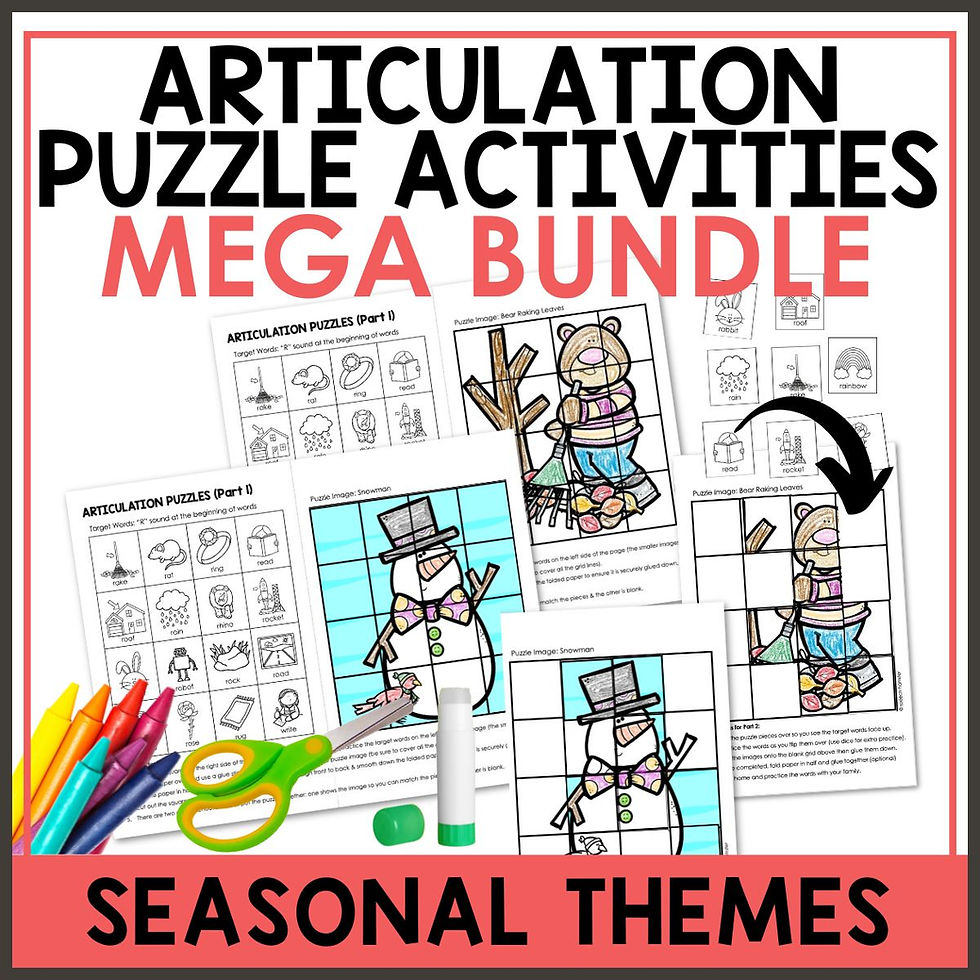
Articulation Puzzles Growing Bundle
Language:
Vocabulary: Review or list words associated with puzzles such as: piece, match, fit, edge, corner, pattern, complete.
Following Directions:
Quantitative (number or amount): put three puzzle pieces on the table, place all the edge pieces in a pile, etc.
Qualitative Directions (describing qualities): Pick the smallest puzzle piece, choose the smooth piece instead of the rough one, etc.
Temporal (time or order): First find the corner piece, then add one edge piece.; Put the piece in place after you flip it over; Before you add another piece, say your name.
Conditional (if/when/unless): If the piece has a flat edge, put it on the side, When the puzzle is finished, raise your hand, etc.
Figurative Language: Grab Catherine Reed's free Figurative Language Puzzles on Teachers Pay Teachers.
Compound Words: Use Sam Nowak's free Compound words puzzle activity on TpT
Free Resources: Browse through the free puzzle themed resources for speech therap on TpT.
January 30:
🦖 Draw a Dinosaur Day (January 30)
About: This day encourages creativity and imagination through drawing. Dinosaurs are a popular topic that supports descriptive and narrative language.
Fun Facts:
Dinosaurs were first scientifically identified in the 1800s, long after their extinction.
Many dinosaur illustrations have changed over time as new fossil evidence is discovered.
Drawing is often used in science education to help learners organize and retain information.
Directed Drawing: Check out Mrs. Ishu's free Step By Step Directed Drawing Worksheets that includes a dinosaur option on TpT.
Dot to Dots: Browse through these free dinosaur dot to dot activities on TpT.
Vocabulary: Review dinosaur parts before adding them to a drawing: tail, claws, teeth, spikes, horns, scales.
Design a Dinosaur: Ask students to draw a brand-new dinosaur species and explain its name, features, and abilities.
Popular Children's Books:
How Do Dinosaurs Eat Their Food? – Written by Jane Yolen, illustrated by Mark Teague: Dinosaurs model both good and bad table manners in this humorous rhyming story. 📖 [Amazon Link] 🎥 [YouTube Read Aloud]
How Do Dinosaurs Clean Their Rooms? – Written by Jane Yolen, illustrated by Mark Teague: This playful board book shows messy dinosaurs stomping, hiding toys, and making excuses -before turning it around and helping clean up. 📖 [Amazon Link] 🎥 [YouTube Read Aloud]
How Do Dinosaurs Say Goodnight? – Written by Jane Yolen, illustrated by Mark Teague:A playful look at bedtime routines with some not-so-sleepy dinosaurs who pout, stomp, and roar their way toward lights out. It’s a mix of humor and heart with rhythmic text.📖 [Amazon Link] 🎥 [YouTube Read Aloud] 🛒 [Free Resources on TpT]
January 31:
🔁 National Backwards Day (January 31)
About: National Backwards Day encourages playful thinking by reversing routines or ideas. It works well for language flexibility and sequencing.
Fun Facts:
Reversing routines can help strengthen memory and attention by breaking predictability.
Playing with order and sequence supports flexible thinking and planning skills.
Backwards reasoning is often used in problem solving and math.
Articulation:
After a set number of correct productions, flip a card to reveal the “backwards” version of the word or picture.
Practice target words in phrases or simple sentences, then repeat the phrase or sentence backwards (last word first) for fun contrast. How long of a sentence can students say backwards correctly?
Vocabulary: review backwards, reverse, forwards, first, last, before, after, rewind, opposite.
Sequencing: List out familiar routines and have students sequence the routine from finish to start.
Backwards Session:
Have students walk backwards to your speech room.
Create a schedule for your session and then complete it backwards.
Open Ended:
Backwards Numbers: Roll a dice and have students name the next number in reverse order. Complete the same number of trials/tasks.
Forwards/Backwards dice: With odd numbers = moving game piece backward and even numbers = moving game piece forward, see how long it takes to complete a board game while completing speech/language tasks.
Number Mats: Use Ms. K's Kreations' free Counting Backwards Number Mats and fill in the blanks after completing trials/tasks.
Popular Children's Books:
Brunhilda’s Backwards Day – Written by Shawna J. C. Tenney: Brunhilda the witch loves doing everything the wrong way, from her morning routine to how she treats others. When her backwards habits begin to affect everyone around her, the story explores reversed routines, cause and effect, and what happens when familiar patterns are turned upside down. 📖 [Amazon Link] 🎥 [YouTube Read Aloud]
Duck! Rabbit! – Written by Amy Krouse Rosenthal, illustrated by Tom Lichtenheld: Two characters see the same image in different ways. The story supports perspective taking. 📖 [Amazon Link] 🎥 [YouTube Read Aloud] 🛒
☕ National Hot Chocolate Day (January 31)
About: A day for enjoying a cozy winter drink. In classrooms, it is often adapted into pretend play or sequencing activities.
Fun Facts:
Hot chocolate originated as a bitter drink consumed by ancient Mesoamerican civilizations.
Sweetened versions became popular in Europe after sugar became more widely available.
Warm drinks are often associated with comfort rituals and seasonal traditions.
Free Resources: There are so so many free hot chocolate themed resources and activities that can be used for speech-language therapy. You'll find resources designed specifically for speech or language targets or resources that can be used as an open-ended craftivity.
Vocabulary: Review or list hot chocolate themed relational words such as cocoa, chocolate, warm, melt, mug, marshmallows, sweet, creamy.
Sequencing: List out the steps for making hot chocolate
Describing: Describe how hot chocolate is the same or different from other drinks.
Following Directions: Have students follow a variety of directions using a mug and mini marshmallows. For example: Drop two marshmallows into the cup, Put a marshmallow behind/in front of the cup, Put all the marshmallows in the cup except one.
WH Questions:
What goes into hot chocolate?
Where do you drink it?
When do people like to have it?
Why do people drink it when it’s cold?
How do you make it warm?
Popular Children's Books:
Hot Cocoa Calm – Written by Kira Willey, illustrated by Anni Betts: This gentle mindfulness story invites children to imagine holding a warm cup of hot cocoa while practicing calm breathing. The book guides readers through sensory details and simple relaxation strategies to support emotional regulation and focus. 📖 [Amazon Link] 🎥 [YouTube Read Aloud]
Do Frogs Drink Hot Chocolate? – Written by Etta Kaner, illustrated by John Martz: This non-fiction book explores questions about what animals eat and drink, using clear explanations and engaging visuals. 📖 [Amazon Link] 🎥 [YouTube Read Aloud]
Creative Themes that Carry January Forward
There is plenty more to explore in the last days of January. From flexible thinking on National Opposite Day (January 25) to building and reasoning on National Lego Day (January 28) and National Puzzle Day (January 29), these themes offer varied entry points for meaningful speech and language practice. Each day's themes and ideas keep learning moving right into the next month.
See More National Day Themes for January:
January National Days Week 1 (January 1 - 7)
January National Days Week 2 (January 8 - 14)
January National Days Week 3 (January 15 - 21)
Quick Link to View All 12 Months: 10 Reasons to Use National Day Themes for Easy Speech Therapy Planning (each month's themes are noted at the end).

Hi! I'm Shannon, creator of Speech Hamster. If you have found the information in this blog post useful, there's more where that came from! Subscribe to the Speech Hamster Newsletter to gain access to the Free Resource Library; a hub containing a host of National Days downloadable resources and so much more!
Portions of this blog post were drafted with AI prompt assistance then reviewed and edited by me.


Comments