

National Day Themes in January - Week 2: Speech and Language Activities for Early Elementary
- shannon | speech hamster

- Jan 8
- 14 min read
Updated: Jan 26
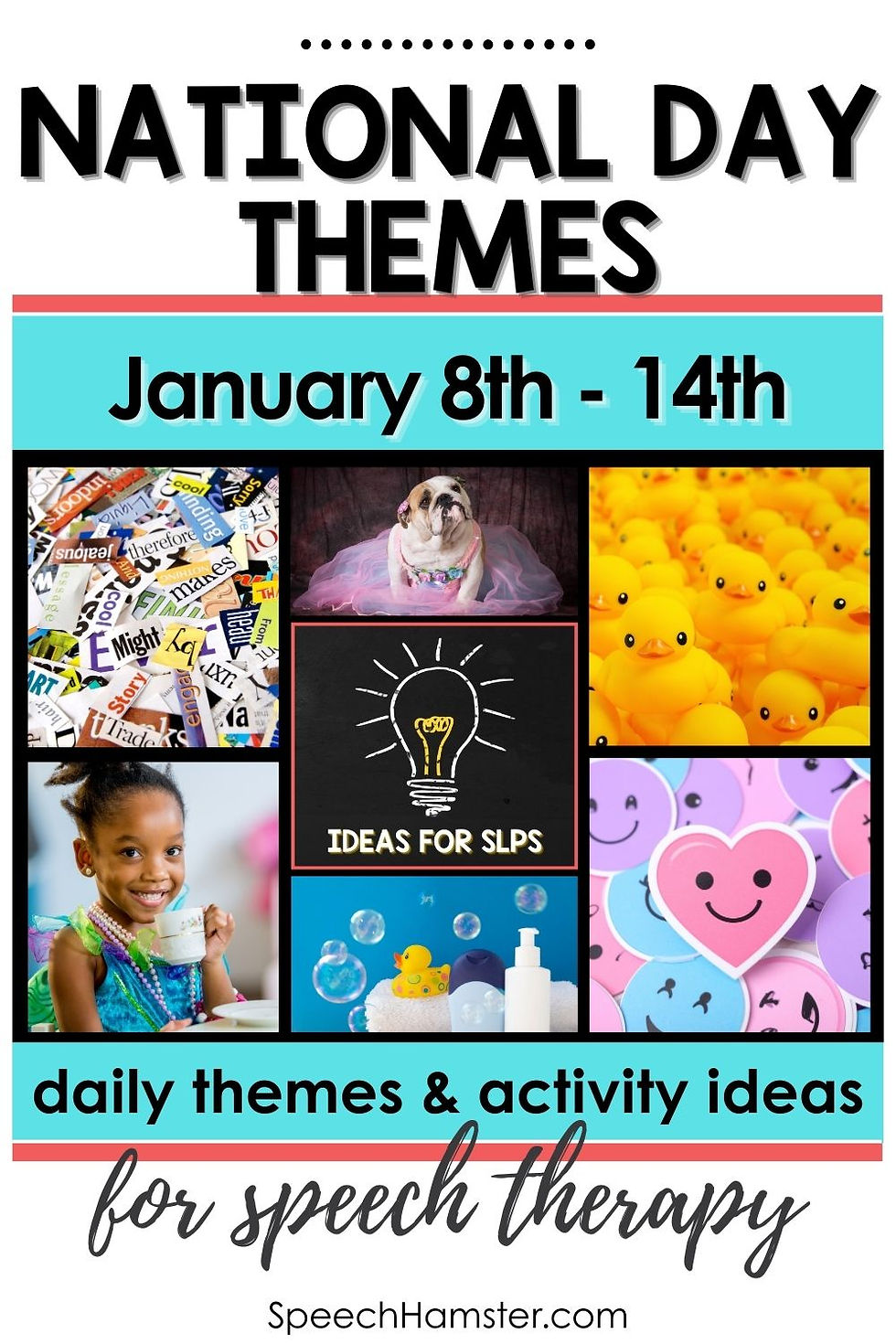
January 8 - 14 (Week 2)

January continues to offer themes that ease students back into routines with hands-on activities, sensory play, and plenty of opportunities for conversation. This week’s national days lean into warmth, creativity, curiosity, and the kind of simplicity that helps keep sessions intentional without adding stress. These themes open natural doors for describing, sequencing, and joyful play as students settle back into the new year.
Welcome to National Days in January Week 2! From engaging the senses on National Bubble Bath Day (January 8), imaginative vocabulary play for National Word Nerd Day (January 9), to collaborative crafting for National Hot Tea Day (January 12), using national day themes can bring structure and creativity into sessions effortlessly with activities that feel fresh and playful all week long.
This blog post contains affiliate links, which means I receive a commission if you make a purchase through them, with no extra cost to you.
Use the table below to explore some of the national days celebrated the second week in January. To avoid scrolling fatigue, use the quick links to view activity ideas and book suggestions for each theme.
View additional weeks in January:
January National Days Week 1 (January 1 - 7)
January National Days Week 3 (January 15 - 21)
January National Days Week 4+ (January 22 - 31)
To view themes for all 12 months head over to 10 Reasons to Use National Day Themes for Easy Speech Therapy Planning.
*Free resource links listed here may change over time. Please check the original source for current availability and terms.
January National Days Week 2
Date | National Day Quick Links |
January 8 | |
January 9 | |
January 10 | |
January 11 | |
January 12 | |
January 13 | |
January 14 |
January 8:
🛁 National Bubble Bath Day (January 8)
About: National Bubble Bath Day celebrates the simple joy of warm water and bubbles. It’s an easy, playful theme for speech sessions, offering natural opportunities for describing, sequencing, and imaginative play.
Fun Facts:
Bubble baths became popular in the 1940s when soap flakes were added to warm water.
Bubbles pop faster in dry air and last longer in humid rooms.
The rainbow colors on bubbles come from light reflecting off the thin layer of soap.
Articulation: Hide articulation cards in a bin of cotton-ball “bubbles.” Students scoop a bubble (or blow on the "'bubbles") to uncover the word then practice it before scooping/blowing again.
Phonological Awareness:
Clap out syllables for bubble words such as bathtub, soap, slippery, water, shampoo, translucent.
Generate rhymes for bath, tub, soap, splash, clean, water, etc.
Vocabulary:
Discuss words like bubbles, sponge, soak, scrub, slippery, rinse, foam, float, smooth, soap, squishy, fluffy, warm, etc.
Dirty vs. Clean: use plastic toys (some with dry erase marks on them, some without). Categorize toys as dirty or clean. Add the dirty toys into a bin full of soapy water to clean them.
Category Sort: Sort items into bath toys vs. not bath toys.
Predictions: Sink or Float: have students make predictions about whether different items will sink or float in a tub of soapy water. Test out their predictions and graph the outcomes.
Following Directions: Using different bath toys and a bin of soapy water, have students follow temporal or conditional directions. Examples:
Temporal: First put the rubber duck in the bath, then the sponge.
Conditional: If the rubber duck is yellow, say 'quack' one time. If the rubber duck is pink, say 'quack' two times.
Crafts:
Paper Tub & Bubble Craft: Students cut and glue "bubble" shapes above a tub.
Bubble Stamp Painting: Use white paint and sponges or corks to make bubble prints.
Open Ended Activities:
Bubble Sensory Bin: Cotton balls, pom-poms, cut up sponges, rubber ducks for any goal.
Bubble Jar Reinforcement: Fill a jar with “bubbles” (cotton balls) as students complete tasks.
Sticker Bubbles: Round stickers become bubbles on any articulation or language sheet. Try out these transparent circle sticky notes (Amazon).
Popular Children's Books:
The Pigeon Needs a Bath! – Written and illustrated by Mo Willems: Pigeon insists he doesn’t need a bath—until he finally tries one. Great for emotions, persuasion, and character voice. 📖 [Amazon Link] 🎥 [YouTube Read Aloud] 🛒 [Free Resources on TpT]
Bathtime for Biscuit – Written by Alyssa Satin Capucilli, illustrated by Pat Schories: Biscuit resists taking a bath but ends up enjoying the splashy fun. Simple sentences support sequencing and early retell. 📖 [Amazon Link] 🎥 [YouTube Read Aloud]
Harry the Dirty Dog – Written by Gene Zion, illustrated by Margaret Bloy Graham: Harry hides from bath time, gets very dirty, and returns home unrecognizable. Perfect for discussing routines, cause and effect, and comparing before/after. 📖 [Amazon Link] 🎥 [YouTube Read Aloud] 🛒 [Free Resources on TpT]
Mrs. Wishy Washy's Farm – Written by Joy Cowley, illustrated by Elizabeth Fuller: Farm animals repeatedly get dirty and are promptly washed clean by Mrs. Wishy-Washy. The repetitive structure supports early sequencing, predicting, and expressive language. 📖 [Amazon Link] 🎥 [YouTube Read Aloud] 🛒 [Free Resources on TpT]
January 9:
🔤 National Word Nerd Day (January 9)
About: National Word Nerd Day celebrates people who love words, books, and language play. It’s a natural fit for vocabulary development, describing, and exploring new or silly words in speech therapy.
Fun Facts:
The English language has over one million words.
A “logophile” is someone who loves words.
New words are added to the dictionary every year as language changes.
Articulation:
Word Nerd Points: Students rely on memory of target words they've practiced in the past to recall words that contain their target sound. Each word earns a “word nerd point.”
Build-a-Word: Using magnetic letters (or similar), students practice target words to earn letters. The first to build a word with the letters wins!
Dictionary Dive: Here's a blast from the past...dictionaries! Students look to find words that begin with their target sound and create a practice list for the session.
Phonological Awareness:
Syllable Sorting: Sort vocabulary words by number of syllables.
Sound Swap Words: Change the first sound of a word to create new silly words.
Vocabulary:
Big Words, Small Explanations: Introduce fun words (or tier 2 and 3 words) and have students guess their definition or name synonyms.
Word Categories: Sort words into groups such as describing words, action words, or naming words.
Word of the Day: Choose one word to use throughout the session. Count how many times the word is used "meaningfully".
Listening:
Definition Detective: Read a simple definition and have students guess the word.
Which Word Did I Say?: Say a sentence and have students identify which word was the character, action word, etc.
True or Silly?: Students decide if a word used in a sentence is a real word or a silly word.
Describing:
Describe the Word: Students describe a word using attributes (what it means, what it’s used for).
Word Comparison: Compare two words and explain how they are the same or different.
Sentence Stretching: Expand short sentences by adding descriptive words.
Sequencing:
Sentence Order: Put scrambled sentence strips in the correct order.
Story Vocabulary Order: Arrange vocabulary words in the order they appear in a short story.
Narratives:
Word Comes to Life: Students create a story where a word becomes a character. What word would they choose?
Three-Word Story: Build a story using three assigned vocabulary words.
Word Trouble Story: A character misunderstands a word. What happens next?
Crafts:
Word Nerd Badge: Create a badge featuring a favorite word.
Mini Dictionary: Students make a personal word book.
Speech Bubble Craft: Write favorite words inside speech bubbles.
Word Poster: Decorate and illustrate one vocabulary word.
Open Ended Activities:
Word Jar Pull: Students pull a word and decide how to use it.
Spin-a-Word: Spin to select a task such as define, use, or describe.
Word Charades: Act out words for others to guess.
Popular Children's Books:
The Word Collector – Written and illustrated by Peter H. Reynolds: Jerome collects words of all kinds and discovers how powerful they can be. This story highlights curiosity, word appreciation, and expressive language. 📖 [Amazon Link] 🎥 [YouTube Read Aloud] 🛒 [Free Resources on TpT]
Big Words for Little Geniuses – Written by Susan and James Patterson, illustrated by Hsinping Pan: This playful book introduces unusual and interesting words with kid-friendly explanations. It encourages curiosity and word exploration. 📖 [Amazon Link] 🎥 [YouTube Read Aloud]
Frindle – Written by Andrew Clements: A student invents a new word and watches it spread beyond his classroom. The story explores how words are created and how language evolves. 📖 [Amazon Link] 🛒 [Free Resources on TpT]
January 10:
🪴 National Houseplant Appreciation Day (January 10)
About: National Houseplant Appreciation Day encourages people to notice and care for indoor plants. This theme pairs beautifully with describing words, sequencing steps, and conversations about growth.
Fun Facts:
Houseplants can help clean indoor air by absorbing certain chemicals.
Plants grow toward light in a process called phototropism.
Spider plants and pothos are two of the easiest houseplants for beginners.
Articulation: Students create a paper plant and add leaves, flowers, or stems after a set number of correct productions.
Language:
Vocabulary: Introduce words such as root, stem, leaf, soil, pot, water, fertilizer, grow, trim, feed, wilt.
Sequencing: seed → soil → water → plant.
Following Directions: Have student's place plant pictures above, under, next to objects.
Describing: compare and contrast different types of houseplants.
Narratives: Create a beginning, middle, and end for a story such as The Plant that Wouldn't Grow or My Talking Plant.
Open-Ended / Crafts: Use crayons to make leaf rubbings.
Popular Children's Books:
The Tiny Seed – Written by Eric Carle: Follows the journey of a tiny seed as it travels, grows, and becomes a giant flower, teaching children about plant life cycles. 📖 [Amazon Link] 🎥 [YouTube Read Aloud]
Planting a Rainbow – Written and illustrated by Lois Ehlert: A vibrant, simple book that teaches children about different flowers and colors as they grow a garden. 📖 [Amazon Link] 🎥 [YouTube Read Aloud]
January 11:
📡 Learn Your Name in Morse Code Day (January 11)
About: Learn Your Name in Morse Code Day invites students to explore a communication system made of dots and dashes. It’s a compelling way to talk about patterns, symbols, and different ways people send messages.
Fun Facts:
Morse code was invented in the 1830s and used for long-distance communication.
Each letter of the alphabet has its own pattern of short and long signals.
SOS (· · · — — — · · ·) is the most well-known Morse code message.
Morse Code Printables:
Grab this free download on teachersprintables.net.
Check out MrWatts' free Morse Code Poster on Teachers Pay Teachers.
Morse Name Bracelet: Beads represent dots and dashes. Check out Katie Stokes' free Morse Code Your Name Bracelet Craft on Teachers Pay Teachers.
Articulation: Students decode alphabet cards written out in dots and dashes then practice target words (dot = once, dash = twice).
Phonological Awareness: Students tap out a letter in Morse code, then name a word beginning with that letter sound.
Vocabulary: Discuss words like dot, dash, signal, code, message, pattern, symbol, tap, blink, send, receive, decode, short, long, fast, slow.
Following Directions:
Follow directions to tap specific dot/dash sequences.
Decode a letter, then complete the action tied to it. (e.g., a = clap your hands 3 times, b = touch your nose, c = move closer to the door)
January 12:
🍵 National Hot Tea Day (January 12)
About: National Hot Tea Day celebrates warm, soothing tea and the traditions surrounding it. This theme works well for pretend play, sequencing steps, and using sensory language.
Fun Facts:
Tea is one of the oldest beverages in the world, first enjoyed in China over 4,000 years ago.
Black, green, and white teas all come from the same plant.
People have used tea in ceremonies and celebrations for centuries.
Articulation:
Memory/Matching: Download my free Teapot - Teacup Match Up activity. Match the teacups to teapots while practicing /s/ in the initial word position. This activity also includes matching for compound word creations.
Hide & Find: Hide a "biscuit" or other tea party treat under one of an assortment of teacups. Practice target words while searching for the treat.
Phonological Awareness:
Rhyming: create a list of words that rhyme with "tea", "cup" and "pot".
Letter/Sound Correspondence: Grab Party In Pre-K's free Tea Time Alphabet Game (TpT) to practice letter-sound correspondence.
Phoneme Substitution: replace the first sound in "tea", "cup" and/or "pot" to create new words.
Compound Words: Download the free Teapot - Teacup Match Up listed above. Match the teacup and teapot to formulate compound words.
Language:
Vocabulary: Play Tenth Line Games free Tea Party Bingo to reach/review tea party themed vocabulary.
Tea Party: Structured Fun Teaching created a free Dramatic Play Tea Party Kit for preschooler-aged learners.
Sequencing: Teach and review the steps for setting a table for a tea party using temporal concept words (e.g., first, then, next, before, after, etc.).
Origami Cup Craft: Watch How to Make an Origami Cup on You Tube and then see if students can follow your directions to make their own.
Popular Children's Books:
Tea Rex – Written by Molly Idle: A proper tea party takes a wild turn when a dinosaur comes to visit! This humorous and beautifully illustrated story is great for teaching manners, sequencing, and describing silly events. 📖 [Amazon Link] 🎥 [YouTube Read Aloud]
A Tea Party in the Woods – Written and Illustrated by Akiko : When a girl sets out to deliver food to her grandmother, she stumbles upon a magical woodland tea party hosted by animals. With gentle, dreamlike illustrations, this story supports narrative language, description, and inferencing. 📖 [Amazon Link] 🎥 [YouTube Read Aloud]
January 13:
⭐ National Sticker Day (January 13)
About: National Sticker Day celebrates stickers as fun tools for decorating, sorting, and creating. In speech therapy, stickers make perfect reinforcers and support describing, categorizing, and following directions.
Fun Facts:
The first sticker-like labels were used in the 1800s for advertising.
Kids collect millions of stickers every year.
Stickers can be made from paper, plastic, foil, or even fabric.
Articulation:
Stick and Say: Students earn one sticker for every set number of correct productions and place it on a scene or chart.
Sticker Target Board: Place stickers over articulation words after students practice the word a set number of times.
Sticker Trail: Create a simple path; students place a sticker on each space after saying a target word or set of words.
Build-a-Scene Practice: Students add a sticker to a scene after completing a round of articulation trials.
Language:
Vocabulary: Sort and label stickers by category such as animals, food, transportation, people, or actions. Introduce descriptive words like colorful, tiny, shiny, smooth, and bright.
Following Directions: Follow positional or sequential 1–2 step directions for placing stickers (above, next to, under, first, last).
Narratives: Create a short story using 3–5 stickers. Students tell what is happening, what problem occurs, and how it is solved.
Describing : Use adjectives to describe size, color, shape, placement and details.
Narratives: Each student adds a sticker and contributes to the narrative.
Open Ended: Allow students to freely create a sticker scene and explain their choices using complete sentences.
Sticker Books:
Reusable Puffy Sticker Books for Kids – Melissa & Doug products: Children create scenes and stories using reusable stickers. 📖 [Amazon Link]
🦆 National Rubber Ducky Day (January 13)
About: National Rubber Ducky Day honors the classic bath toy known for bright colors and friendly faces. This theme is ideal for imaginative play, describing, and early language concepts.
Fun Facts:
Rubber ducks became popular in the 1940s when latex toys were widely produced.
The world’s largest rubber duck is over six stories tall.
Rubber ducks float because they are filled with air, making them less dense than water.
Articulation:
Duck Race: Use white circles to represent bubbles. Use these to create a path across a table (game board style). Students say a target word before moving a rubber duck across the bubble shapes.
Floating Ducks: Use a dry erase marker to write a number on the bottom of each rubber duck. Float ducks in a tub of water. Students choose a duck and practice the same number of words.
Phonological Awareness:
Beginning Sound Pond: Sort picture cards by initial sound into different duck ponds.
Rhyming Ducks: Match ducks with rhyming word pairs.
Vocabulary:
Duck Descriptors: Describe ducks using color, size, pattern, and texture.
Action Verbs: Name or act out verbs related to playing with a rubber duck such as float, dive, splash, quack.
Sorting: Use Raven Education's free Rubber Ducks File Folder Activity on Teachers Pay Teachers to sort ducks by size. You can also use the big/small ducks in an open ended game (e.g., big = # of trials, small = # of trials).
Listening:
Duck Directions: Follow 1–2 step directions to move ducks around a bath scene.
Which Duck?: Listen to a description and identify the correct duck.
Yes or No: Decide if a spoken sentence about ducks makes sense.
Listening for Details: Listen to a short duck story and answer WH questions.
Duck Clue Game: Students listen to clues to guess the hidden duck.
Describing:
Describe the Duck: Use attributes such as color, size, shape, and details.
Where Is the Duck?: Describe location using positional words. Use Communication Tidbit's free Where is the Rubber Duck? adapted book on Teachers Pay Teachers.
Following Directions:
Duck Placement Directions: Follow multi-step directions using above, under, next to.
Conditional Duck Tasks: If the duck is yellow, place it in the tub; if blue, place it on the towel.
Duck Clean-Up: Follow directions to organize ducks by size or color.
Narratives:
The Duck Who Got Lost: Tell a beginning, middle, and end story.
Duck’s Big Splash: Create a short narrative about bath-time trouble.
Group Duck Story: Each student adds one sentence to a shared story.
Crafts:
Paper Duck Craft: Cut, glue, and decorate a duck for storytelling.
Duck Clip Art: Red Cardinal Crafts (TpT) offers free 5 Little Ducks Clip Art you can use to create the story, build crafts or design your own activity.
Popular Children's Books:
10 Little Rubber Ducks: Written and illustrated by Eric Carle: Ten rubber ducks are swept into the ocean and drift to different places, meeting a variety of animals along the way. 📖 [Amazon Link] 🎥 [YouTube Read Aloud] 🛒 [Free Resources on TpT]
January 14:
🐾 National Dress Up Your Pet Day (January 14)
About: National Dress Up Your Pet Day encourages safe, lighthearted ways to dress pets in fun outfits. This theme naturally sparks describing, storytelling, and lots of conversation.
Fun Facts:
Pet clothing has existed since ancient times and has grown into a modern industry.
Some pets wear clothing to stay warm, while others wear it just for fun.
The most popular pet costumes include sweaters, scarves, bow ties, and superhero capes.
Articulation:
Dress and Say Craft: Students create a paper pet and add one clothing piece after a set number of correct productions.
Outfit Builder: Each set of articulation trials earns a new accessory (hat, bow, scarf, boots) to dress a stuffed animal.
Language:
Vocabulary: Introduce clothing and accessory words such as costume, outfit, accessory, pattern, stripe, fancy, fluffy, shiny, cozy, loose, tight.
Following Directions: Follow positional or sequential 1–2 step directions to dress the stuffed animal "pet".
Sequencing: Order events for getting ready for a pet fashion show or sequence how to dress a pet from start to finish.
Narratives: Tell a beginning, middle, and end story about a pet fashion show. Describe a problem (the pet doesn’t like the outfit) and how it is solved.
Open Ended: Let students design their own outfit and explain their choices.
Playful Patterns and Practical Practice in January Week 2
From exploring patterns on Learn Your Name in Morse Code Day (January 11), to bright reinforcement opportunities on National Sticker Day (January 13) and whimsical storytelling for National Rubber Ducky Day (January 13) plus more, each day offers its own angle for practicing speech targets, vocabulary, sequencing, describing, and conversational skills, giving you a full range of low-demand, high-engagement options. It’s an easy way to keep therapy moving forward with variety and charm, even as everyone is still finding their January rhythm.
See More National Day Themes for January:
January National Days Week 1 (January 1 - 7)
January National Days Week 3 (January 15 - 21)
January National Days Week 4+ (January 22 - 31)
Quick Link to View All 12 Months: 10 Reasons to Use National Day Themes for Easy Speech Therapy Planning (each month's themes are noted at the end).

Hi! I'm Shannon, creator of Speech Hamster. If you have found the information in this blog post useful, there's more where that came from! Subscribe to the Speech Hamster Newsletter to gain access to the Free Resource Library; a hub containing a host of National Days downloadable resources and so much more!
Portions of this blog post were drafted with AI prompt assistance then reviewed and edited by me.


Comments