

National Day Themes in February - Week 2: Creative Ideas for Speech & Language Therapy

Updated: Jan 26
February 8 - 14 (Week 2)
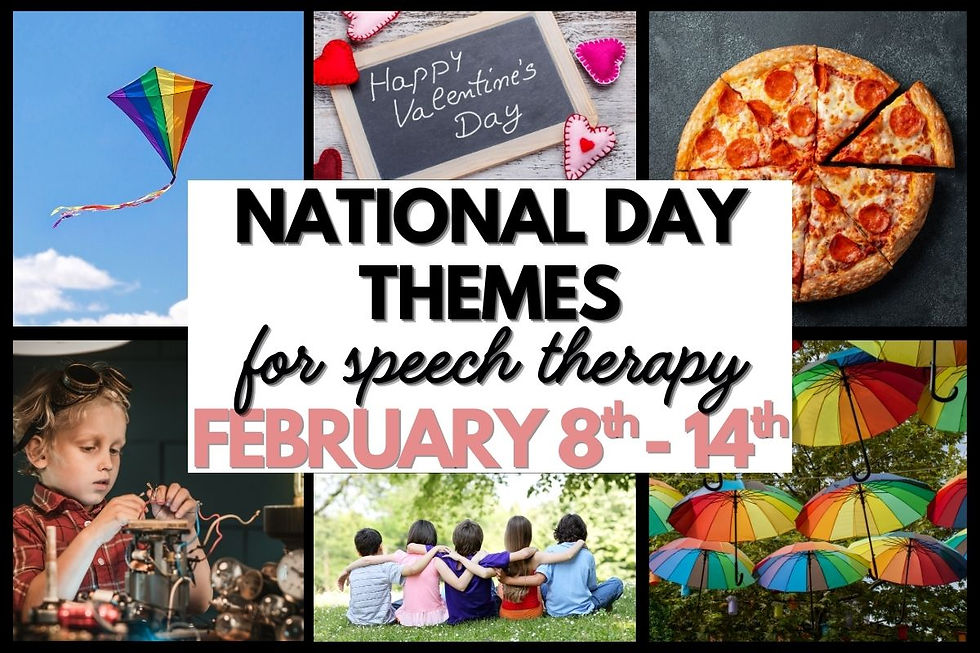
Just when the month starts to feel like it’s dragging, February's National Days swoop in with more fresh and fun themes! Whether you’re celebrating kindness, creativity, or a classic comfort food, these themed days add variety to your sessions while reinforcing important speech and language skills.
Welcome to National Days in February Week 2. Whether you're building vocabulary with cheesy fun on National Pizza Day (February 9), flipping for language practice with Lost Penny Day (February 12), or encouraging thoughtfulness and meaningful conversations for Apology Day (February 13), these themed ideas might be just what you need to turn the mid-winter slump into a speech therapy win.
This blog post contains affiliate links, which means I receive a commission if you make a purchase through them, with no extra cost to you.
Use the table below to explore some of the national days celebrated the first week in March. To avoid scrolling fatigue, use the quick links to view activity ideas and book suggestions for each theme.
View additional weeks in February:
February National Days Week 1 (February 1 - 7)
February National Days Week 3 (February 15 - 21)
February National Days Week 4 (February 22 - 29)
To view themes for all 12 months head over to 10 Reasons to Use National Day Themes for Easy Speech Therapy Planning.
*Free resource links listed here may change over time. Please check the original source for current availability and terms.
February National Days Week 2
(Month-long observances: Black History, American Heart)
Date | National Day Quick Links |
Feb 8 | |
Feb 9 | |
Feb 10 | |
Feb 11 | |
Feb 12 | |
Feb 13 | |
February 14 |

February 8:
🪁 National Kite Flying Day (February 8)
About: celebrated to honor the joy, creativity, and history of kite flying. Kites have been flown for thousands of years, originally invented in China as early as 2,800 years ago.
Fun Facts:
The earliest kites were made from bamboo and silk.
Kites have been used for weather research, communication, and even military operations.
Benjamin Franklin used a kite to study electricity during a thunderstorm.
Articulation:
Craftivity: Cut out a kite shape and attach a long piece of string. Have students choose an articulation card, practice it, and then lay it down on the string as kite tails OR download and use this free Kite Craftivity by Ashley Lafleur on TpT and write target words on the tails.
Multisyllabic Words: Check out The SLP Scrapbook's free, no prep Multisyllabic Words Speech Kites Craft on TpT.
Language:
Antonyms: Speech Dreams created this Spring Kite Speech Therapy Activity (TpT). Just add stickers!
Plural Nouns: Check out Lindsey Karol's High Flying Kites resource for regular and plural nouns (TpT).
Synonym or Homophone: View Speech Time Fun's Kite Flying Fun synonym or homophone printable (TpT).
Popular Children's Books:
Stuck – Written and illustrated by Oliver Jeffers: When Floyd’s kite gets stuck in a tree, he throws everything he can think of to knock it down, leading to a hilarious chain of events. 📖 [Amazon Link] 🎥 [YouTube Read Aloud]
The Wind Blew – Written and illustrated by Pat Hutchins: A gusty wind sweeps through town, blowing away umbrellas, hats, and a kite, creating a fun, repetitive story about the power of nature. 📖 [Amazon Link] 🎥 [YouTube Read Aloud]
Kite Day: A Bear and Mole Story – Written and illustrated by Will Hellenbrand: Bear and Mole work together to build a kite and wait for the perfect windy day to fly it. When a storm rolls in and their kite blows away, they discover a sweet surprise waiting in the branches of a tree. 📖 [Amazon Link] 🎥 [YouTube Read Aloud] 🛒 [Free Resource on TpT]
February 9:
🍕 National Pizza Day (February 9)
About: A fun food holiday celebrated in the U.S. to honor one of the most popular dishes in the world—pizza! Pizza has its roots in Italy, but became a beloved staple in America in the early 20th century.
Fun Facts:
The first pizzeria in the U.S. opened in New York City in 1905.
Americans eat about 3 billion pizzas each year.
There’s even a pizza delivery service that has sent pizza to space!
Articulation:
Speecha Pizza: A free articulation game for /k/ created by SpeechTacular on Teachers Pay Teachers.
Roll and Practice: Peachie Speechie has made a Pizza Party Roll & Race worksheet that would work well for articulation practice.
Play Dough Pepperoni: Roll dice, Practice the same number of target words then squish red play dough balls into pepperonis and place on a drawn pizza shape.
Language:
WH Questions: Play this free WH-Questions Pizza Party Game created by Miss V's Speech World on Teachers Pay Teachers.
Pronoun Pizza: Teach Two Reach has made this Pronoun Pizza activity (TpT).
Following Directions: Use this Build A Pizza counting activity created by Chaney Homeschool (TpT) for following directions.
Free Mini Units on Teachers Pay Teachers:
Pizza Mini Unit (Made for Me Literacy)
Pizza Preschool Unit by Itty Bitty Speech (includes Boom Cards)
Free Boom Cards: Browse these free Pizza Themed Boom Cards on Boom Learning.
Popular Children's Books:
Pete’s a Pizza – Written and Illustrated by William Steig: Pete is having a bad day, so his parents cheer him up by pretending to turn him into a pizza using silly ingredients and lots of imagination. 📖 [Amazon Link] 🎥 [YouTube Read Aloud]
Hi, Pizza Man! – Written by Virginia Walter and illustrated by Ponder Goembel: A fun read-aloud about a child imagining who might deliver her pizza—maybe a pizza dog or a pizza dinosaur! 📖 [Amazon Link] 🎥 [YouTube Read Aloud]
February 10:
☂️ National Umbrella Day (February 10)
About: A fun celebration of the invention that keeps us dry on rainy days. Umbrellas have been used for thousands of years for both sun and rain protection.
Fun Fact: The word "umbrella" comes from the Latin word umbra, meaning shade or shadow.
Articulation:
Umbrella Craft: Grab Chelsea In Sped's Easy Umbrella Craft (TpT) as an articulation activity. Write words on the raindrops and students can glue each of the drops under the umbrella as they practice their target words.
N-Umbrella Cards: Combine these free Umbrella Number Cards (Welcome to Montessori, TpT) with blue play dough for a quick and easy articulation game. Draw a card, practice the same number of words then add the same number of blue play dough raindrops above the umbrella.
Language:
Compound Words: Check out Michelle Hudgeons' It's Raining Compound Words Craftivity on TpT.
Compare and Contrast: Jenn Alcorn created this free What's Under the Umbrella compare and contract activity (TpT).
Prepositional Directions: Grab the interactive book Who is Under the Umbrella? by Speech Universe (TpT) for targeting the concept "under". Use the vocabulary cards for students to follow other prepositional directions.
Boom Cards: Add this Open Ended Spring Showers activity made by Super Social SLP to your boom learning library to use as a reinforcing "decorate the umbrellas" activity.
Popular Children's Books:
Ella's Umbrellas – Written by Jennifer Lloyd and illustrated by Ashley Spires: Ella loves umbrellas and has one for every weather, mood, and outfit. As her collection grows, she must choose between keeping them all or sharing with others. 📖 [Amazon Link] 🎥 [YouTube Read Aloud]
The Umbrella – Written by Jan Brett: In Costa Rica's cloud forests, Carlos drops his umbrella, which curious animals fill. A playful twist sends them tumbling out, leaving Carlos unaware of the adventure inside. 📖 [Amazon Link] 🎥 [YouTube Read Aloud]
February 11:
💡 National Inventor's Day (February 11)
About: National Inventors' Day, established in 1983 by President Ronald Reagan, honors inventors' contributions. Celebrated on February 11, it coincides with Thomas Edison's birthday.
Fun Facts:
Thomas Edison held over 1,000 U.S. patents, including the light bulb and phonograph.
Other famous inventors include the Wright brothers (airplane), Alexander Graham Bell (telephone), and Ruth Wakefield (chocolate chip cookies!).
Many inventions were created by kids—like earmuffs, trampolines, and Popsicles!
Articulation:
Give them the Lead: Present articulation cards/pictures, dice, a spinner, paper, and markers to your students. Ask them to create a new articulation activity and then play/complete it.
Describe & Draw: Students choose 2–3 articulation words and use them in a description of a new invention. After several turns, have them draw their favorite invention.
Phonological Awareness:
Syllable Builders: Say invention-related words like in-ven-tor, ma-chine, but-ton, and ro-bot. Have students clap the syllables or build the word using blocks—one block per syllable.
Rhyme & Design: Say a target word (e.g., light), and have students brainstorm or match rhyming words (e.g., kite, bright, bite). For fun, they can sketch a silly “invention” using two rhyming words (e.g., kite-light, fan-man, glue-shoe).
Language:
Category Naming: List tools, materials, or machines that could be used to create a new invention.
Fix-It Challenges: Present a broken object (e.g., a broken zipper on a backpack, a leaky water bottle) and have students brainstorm inventions that could fix the problem.
Recycled Invention Project: Use cardboard, tape, and recyclables to build a new invention and label its parts.
WH- Question Builders: Use invention-themed picture cards or visuals and ask questions like:
“What is it?”
“Who would use it?”
“Why is it important?”
“Where would you use it?”
Describe It, Don’t Show It: Students describe a mystery invention or tool (e.g., pencil sharpener, flashlight, toaster, fan, scissors) using attributes (shape, color, size, use), while others guess. Make it more difficult by presenting imaginary inventions such as:
Flying Shoes – “You wear these on your feet, and they help you go up into the sky.”
Robot Dog – “It’s a pet that doesn’t need food, and it can do tricks when you push buttons.”
Homework Machine – “It does all your schoolwork while you sleep.”
Invisible Paint – “You put this on a wall, and then it disappears!”
Backpack Vacuum – “You carry this on your back, and it helps clean the room as you walk.”
Popular Children's Books:
Ada Twist, Scientist – Written by Andrea Beaty and illustrated by David Roberts: A story about a curious girl who loves solving problems through science. 📖 [Amazon Link] 🎥 [YouTube Read Aloud]
Rosie Revere, Engineer – Written by Andrea Beaty and illustrated by David Roberts: An inspiring tale about creativity, perseverance, and invention. 📖 [Amazon Link] 🎥 [YouTube Read Aloud]
If I Built a Car – Written By Chris Van Dusen: A young boy named Jack envisions a dream car with whimsical features like a snack bar, swimming pool, and robot driver. 📖 [Amazon Link] 🎥 [YouTube Read Aloud]
😁 National Make a Friend Day (February 11)
About: A day that encourages people of all ages to take a chance on kindness by starting a new friendship. It’s a great day to practice social language, turn-taking, and building connections.
Fun Facts:
Making friends helps boost happiness, confidence, and emotional well-being.
Research shows that friendships formed in early childhood help build communication and problem-solving skills.
You can make a friend by asking questions, listening, sharing, and smiling!
Articulation:
Friendship Bracelet: add beads to a pipe cleaner while practicing target words.
Phonological Awareness:
Syllables: Clap and count syllables in friendship themed words (e.g., hap-py, kind-ness, shar-ing, friend-ship).
Rhyming: Match rhyming words (friend–send, smile–mile, play–day).
Word Chains: Take turns adding words to a list. Each word should start with the same sound the previous word ends with (e.g., friend, dog, gone, nose, zipper, etc.).
Language:
Friendship Words: How many words can your students create using letters from the word "friendship"? Ex: ship, end, find, red, etc.
Popular Children's Books:
My Friend is Sad – Written By Mo Willems: Piggie tries everything to cheer up his friend Gerald—only to learn that simply being there is the best gift of all. 📖 [Amazon Link] 🎥 [YouTube Read Aloud] 🛒 [Free Resources on TpT]
Be a Friend – Written By Salina Yoon: A touching story about a quiet mime boy who makes a friend through shared imagination and understanding. 📖 [Amazon Link] 🎥 [YouTube Read Aloud]
February 12:
👛 National Lost Penny Day (February 12)
About: National Lost Penny Day was created to encourage people to collect and save stray pennies, often overlooked or forgotten. It also commemorates Abraham Lincoln’s birthday, since his image is on the U.S. penny.
Fun Facts:
The first U.S. penny was minted in 1787 and called the “Fugio cent.”
Pennies are made mostly of zinc, with a thin copper coating.
It costs more than one cent to make a penny!
President Abraham Lincoln has been on the penny since 1909.
Penny Toss: Place target words on index cards (or quarter sheets of paper). Have students toss a penny onto a word card. They must say the word 5 times before collecting the penny. the first to collect 10 pennies wins!
Coin Cards: Download these Open Ended Penny and Coin Cards and use for articulation practice. Write target words on back of penny cards (or paperclip image cards to back of penny cards). Have students practice words to collect pennies. Collect 5 pennies for a nickel, two nickels for a dime and so on. How much money can each student collect while practicing their target words? This resource also comes with a 50 Penny Trials worksheet.
Heads or Tails: 2 Player articulation game. Using 16 real pennies, place 8 heads up on the table and 8 tails up. Assign sides: Heads or Tails. Goal: Be the first person to flip all the pennies to one side. To Play: Roll a die and practice the same number of target words. Then flip over the same number of pennies to "heads". Player 2 rolls, practices, then flips same number of pennies to "tails". Repeat until all pennies are either heads or tails.
Following Directions: Set up a "Penny Hunt" where students follow multi-step directions to find hidden pennies.
Listening Comprehension: Browse these free Penny Pusher Listening Comprehension Activities by K Ratliff on Teachers Pay Teachers.
WH Questions:
Who might lose a penny? Who might give you a penny?
What can you buy/do with a penny?
When might someone lose a penny?, When would you need a penny?
Where might you find a lost penny?
Why do people collect pennies?
How can you clean a dirty penny?
Penny Rubbing: Have students place a paper over a penny and color over it with a crayon. Repeat until they've created a page full of multi-colored pennies.
Popular Children's Books:
Patrick Picklebottom and the Penny Book – Written by Mr. Jay and illustrated by Gary Wilkinson: a boy named Patrick discovers that even a single penny can buy a world of imagination when spent on the right book. 📖 [Amazon Link] 🎥 [YouTube Read Aloud]
The Worthless Penny – Written by Greyson Masters: A penny feels insignificant compared to more valuable coins. Through various encounters and a lesson in kindness, the penny discovers its true worth, reminding readers that even the smallest or most overlooked things can have great importance. 📖 [Amazon Link] 🎥 [YouTube Read Aloud] 🛒 [Free Resource on TpT]
Benny’s Pennies – Written by Pat Brisson, illustrated by Bob Barner: Benny has five pennies and uses each one to do something kind for a family member.📖 [Amazon Link] 🎥 [YouTube Read Aloud]
February 13:
😕 National Apology Day (February 13)
About: National Apology Day is observed in Australia to commemorate the 2008 formal apology made to Indigenous peoples for past injustices. In the U.S. context, it's an opportunity to teach children about saying sorry, repairing relationships, and practicing empathy.
Apology Facts:
Saying “I’m sorry” can help restore trust and make people feel better.
A good apology includes acknowledging what happened, taking responsibility, and making a plan to do better.
Learning to apologize is part of growing emotional intelligence and building friendships.
Apology Articulation: Practice target words and brainstorm ways the word could be used within a story scenario that would require an apology. Use the SORRY game board to stay on theme!
Apology Scenarios: Use picture or story scenarios to identify what happened, what went wrong, and how to fix it. Grab Eve Coates' free 4-Step Apology Task Cards on Teachers Pay Teachers. Browse free 4 Step Apology Resources too!
Apology Cards: Decorate mini cards with kind phrases to practice making things right.
Feelings Match-Up: Match facial expressions to apology situations or discuss feelings before and after an apology (i.e., “How did each person feel?”)
Popular Children's Books:
Llama Llama Time to Share – written by Anna Dewdney: Llama learns about sharing, conflict, and the importance of apologizing after a playdate goes wrong. 📖 [Amazon Link] 🎥 [YouTube Read Aloud] 🛒 [Free Resources on TpT]
I’m Sorry – written by Barry Timms, illustrated by Sean Julian: A story of two woodland friends who argue, feel bad, and learn how to reconnect with a sincere apology. 📖 [Amazon Link] 🎥 [YouTube Read Aloud]
February 14:
💘 Valentine's Day (February 14)
About: Valentine’s Day has roots in ancient Roman traditions. Today, it’s widely celebrated as a day to show love and appreciation to friends, family, and loved ones.
Fun Facts:
Over 145 million Valentine’s cards are exchanged each year in the U.S.
The heart shape has been a symbol of love for centuries, but no one is exactly sure why!
In some schools, students give cards and treats to every classmate as a way to include everyone in the celebration.
Articulation:
Collecting hearts: Using mini heart erasers or Valentine stickers, students say a target word 3–5 times before placing or collecting each one.
Hide and Seek: Hide a paper heart under one of 5 or more target words/pictures. Students practice their words while searching for the hidden heart.
Open Ended Card Game: Use the "hearts" cards from a deck of cards and have students pick one from the pile. If they draw a number, they complete the same number of trials (or tasks). The face cards could be wild - have the students determine each wild card represents (e.g., free pass, roll of dice, choose someone else to practice their target words, etc.)
Language:
Describing: Use Valentine’s items to describe by color, shape, texture, or emotion.
Following Directions: Play a game like “Pass the Heart” with multi-step directions.
Sequencing: Retell the steps for making a Valentine’s card.
Narratives: Use sentence starters like “On Valentine’s Day, I gave…” to spark storytelling.
Vocabulary: Teach words like love, care, kind, card, gift, friendship.
Friendship Bracelet Patterning: Use beads or paper strips to make bracelets while practicing language patterns or speech targets.
Free Resources on Teachers Pay Teachers: Browse these free Valentines Day resources related to speech therapy.
Free Resources on Boom Learning: Browse through these Valentine's Day Boom™ Cards sorted for speech therapy and from "free to low to high" in cost.
Craft Activities: Grab my free Valentines Craft Activities on Teachers Pay Teachers.
Popular Children's Books:
The Day It Rained Hearts – written by Felicia Bond: A whimsical story about a girl who catches hearts from the sky and creates handmade Valentines for her animal friends. 📖 [Amazon Link] 🎥 [YouTube Read Aloud] 🛒 [Free Resource on TpT]
Click, Clack, Moo I Love You! – written by Doreen Cronin, illustrated by Betsy Lewin: Little Duck prepares a Valentine’s Day party for all the barnyard animals, spreading love and surprises.📖 [Amazon Link] 🎥 [YouTube Read Aloud] 🛒 [Free Resource on TpT]
Finding Fresh Fun in February’s Week 2 Themes
From staying dry on Umbrella Day to celebrating big ideas on Inventors Day and spreading kindness on Valentine’s Day, this week’s national days will bring plenty of creative ways to liven up your sessions. With even more fun ahead, get ready to carry that energy into Week 3.
See More National Day Themes for February:
February National Days Week 1 (February 1 - 7)
February National Days Week 3 (February 15 - 21)
February National Days Week 4 (February 22 - 29)
Quick Link to View All 12 Months: 10 Reasons to Use National Day Themes for Easy Speech Therapy Planning (each month's themes are noted at the end).

Hi! I'm Shannon, creator of Speech Hamster. If you have found the information in this blog post useful, there's more where that came from! Subscribe to the Speech Hamster Newsletter to gain access to the Free Resource Library; a hub containing a host of National Days downloadable resources and so much more!
Portions of this blog post were drafted with AI prompt assistance then reviewed and edited by me.


Comments